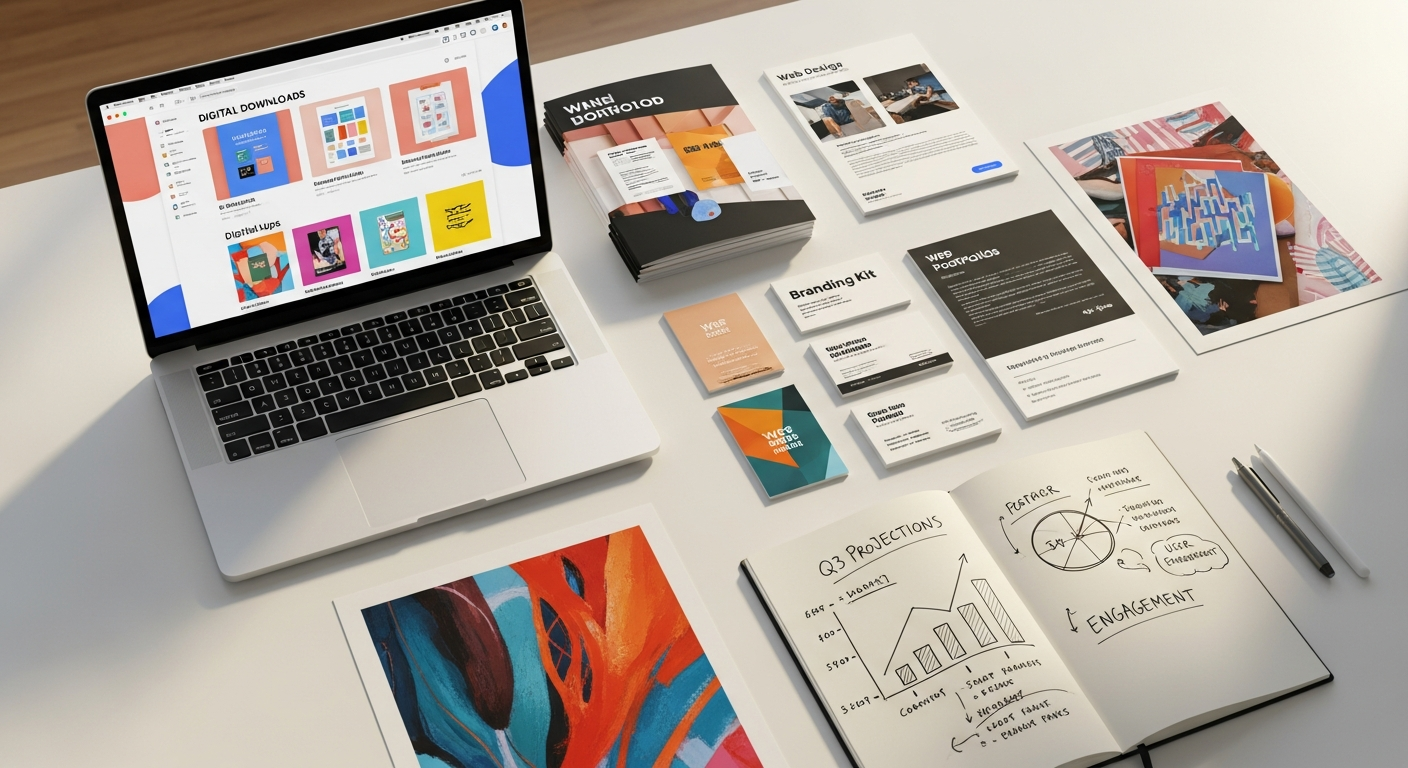
Nearly 60% of creative entrepreneurs report that digital products generate their most consistent revenue stream—and for good reason. Unlike physical goods, digital downloads require zero inventory management, no shipping logistics, and can be sold infinitely without depleting stock. The numbers tell a compelling story: a single design can generate revenue for years, and the overhead costs barely register on a spreadsheet.
Digital downloads have emerged as the go-to business model for designers, artists, and crafters who want to monetize their skills without the headaches of manufacturing and fulfillment. From printable wall art to SVG cutting files, budget templates to digital planners—these intangible assets offer a 98% gross material margin that traditional products simply can’t match. This combination of accessibility and profitability has fundamentally shifted how creators think about business.
This guide unpacks the mechanics that make digital downloads so lucrative, explores the different product categories you can build, and walks through the practical steps to launch your own high-profit craft business. You’ll discover exactly how to price products, optimize for discoverability, and construct systems that generate revenue consistently.
Start building your digital download business today with professional design tools.
The Economics Behind Digital Downloads as a High-Profit Craft
Gross Margin Breakdown: Why 98% Profit Margins Are Achievable
The mathematics of digital downloads are almost absurdly favorable. Once you’ve created a design and uploaded it to a platform, every subsequent sale generates pure profit—minus minimal platform fees. A $10 printable planner costs you virtually nothing to deliver. No paper. No ink. No shipping box. No logistics partner taking a cut.
This 98% gross margin exists because the core business model eliminates the material component entirely. Your “product” is information—a file that exists in the cloud. The buyer downloads it instantly. Your costs remain fixed regardless of how many copies sell.
Cost Structure Analysis: What Actually Costs Money
Design software subscriptions represent your primary ongoing expense. Professional tools like Adobe Creative Suite, Procreate, or Affinity run $10-60 monthly. Platform listing fees on Etsy amount to $0.20 per item listed. Payment processing fees typically take 3-6% of each transaction. These costs are almost negligible when spread across dozens of products and hundreds of sales.
The real investment is time—your creative labor upfront to design products that people want to buy. This isn’t a cost in the traditional sense; it’s the entry barrier that separates successful creators from those who quit early.
Pricing Psychology: How $3-15 Price Points Work Across Categories
Printable wall art sells effectively at $3-8 because buyers perceive these as affordable design experiments. They’re not betting their entire budget on a single purchase. SVG cutting files command $2-5 because the craft community views them as functional tools rather than premium art pieces. Comprehensive planners and budget templates fetch $5-15 because they solve specific problems—organization, financial management, productivity.
Price positioning isn’t about charging what the market will bear. It’s about matching price to perceived value. A 12-month budget template that genuinely saves customers hours of spreadsheet work justifies a $12 price tag. A simple monogram SVG file might only deserve $3.
Scalability Mechanics: Why One Design Generates Revenue Indefinitely
Once you’ve designed a product, the hard work is complete. You don’t manufacture additional units. You don’t manage inventory. You don’t negotiate with suppliers. The design sits in your digital storefront, available for purchase by anyone, anywhere, at any time.
This scalability works in your favor. Design one product well, optimize its listing, and it can generate sales for years. Some creators report that digital products designed five years ago still generate monthly revenue. The cost of serving the 100th customer is identical to the cost of serving the first: zero dollars.
Comparison to Physical Products: The Financial Advantage
Physical product businesses require capital upfront. You design, manufacture a test batch, manage inventory, arrange shipping, handle returns, and deal with unsold stock. Your profit margins reflect these realities—typically 30-50% after all expenses.
Digital downloads eliminate these friction points entirely. There’s no manufacturing risk. No dead inventory. No customer complaints about shipping damage. The comparison is stark: a physical product maker might spend months and thousands of dollars before seeing a sale. A digital product creator can launch within days and start earning immediately.
Revenue Projections: Realistic Earnings Based on Volume and Product Type
Conservative estimates: 10 products selling 10 copies monthly at an average price of $8, with 4% in platform fees, generates $768 in monthly revenue. Scale to 50 products with better optimization, and you’re looking at $3,000+. Scale further with viral listings or smart marketing, and five-figure monthly revenues become achievable.
These projections aren’t theoretical. Thousands of creators on Etsy alone report these numbers. The variable isn’t the platform or the market—it’s the creator’s ability to produce quality designs and market them effectively.
Passive Income Potential: Long-Term Revenue Without Ongoing Labor
This is the real appeal of digital downloads. You invest 20 hours designing a product. You invest 2 hours optimizing its listing. Then you move on to the next project. That original design continues working for you in the background.
Years later, you’re earning revenue from work completed years ago. This isn’t entirely passive—you’ll need to handle occasional customer service questions or update listings as trends shift. But compared to traditional business models, it’s remarkably close to passive income.
Identifying Your Niche Within the Digital Craft Market
Product Category Overview: From Wall Art to Planners
The digital downloads market spans multiple categories, each with distinct buyer psychology and price tolerance. Printable wall art appeals to home decorators and renters seeking affordable aesthetic upgrades. SVG cutting files target crafters using Cricut and Silhouette machines. Digital planners serve productivity-focused professionals and students. Budget templates attract people serious about financial management. Wallpapers, invitations, labels, and stickers round out the landscape.
Each category has different competition levels, price points, and seasonal demand patterns. Wall art sells steadily year-round. Back-to-school templates spike in August. Wedding-related printables peak in spring. Understanding these patterns helps you allocate creative effort strategically.
Target Audience Segmentation: Who Buys Digital Products
Home decorators represent one segment—people who want personalized wall art without the price tag of original artwork. Small business owners seeking templates for invoices, contracts, or client management. Crafters looking for cutting files and design assets. Planners and organization enthusiasts. Budget-conscious consumers who appreciate the price-to-value ratio.
Each segment has distinct pain points. Home decorators want affordable, aesthetically current designs. Small business owners need functional templates that save time. Crafters seek unique designs that differentiate their projects. Understanding which segment you’re serving shapes everything downstream—design choices, pricing strategy, marketing angles.
Market Demand Analysis: Which Products Generate the Most Search Volume
Seasonal trends matter significantly. “Back-to-school planners” spike in July and August. “Christmas printables” surge in October. “Budget templates” see consistent demand, especially in January. “Wedding invitation templates” remain steady throughout the year.
Tools like Etsy search analytics, Google Trends, and Amazon’s search volume indicators reveal what people are actually looking for. Don’t guess about demand. Let the data guide your product development.
Competitive Landscape Assessment: Finding Gaps in Saturated Niches
Wall art is saturated—thousands of sellers offer similar designs. SVG cutting files face less competition but require more design skill. Niche templates (specific to professions, lifestyles, or communities) face less competition than generic planners. The creator who can identify underserved segments wins.
Saturation isn’t necessarily bad. It signals demand. The question becomes: can you offer something distinctly better or different than what already exists?
Trend Research Methods: Identifying Emerging Categories
Pinterest trends reveal what’s gaining traction months before it becomes obvious. Instagram and TikTok show emerging aesthetic preferences. Etsy’s search analytics expose what people are searching for right now. Google Trends data exposes growing interest areas.
The creators who profit most aren’t necessarily trend-followers—they’re trend-spotters who can anticipate what’s about to explode. A creator who noticed minimalist aesthetic gaining traction could design accordingly, before everyone else flooded the market with minimalist products.
Audience Pain Points: Understanding What Problems Digital Products Solve
Someone buying a budget template is solving a problem: they need to get their finances organized. Someone purchasing wall art is solving a different problem: their walls look bare, but they can’t afford custom artwork. Someone buying a content calendar template wants to streamline their workflow.
Products that clearly communicate what problem they solve sell better than products presented as generic designs. “Transform your walls with this 12-piece minimalist gallery wall set” resonates more than “abstract wall art.”
Specialization vs. Generalization: The Narrow Focus Advantage
A creator who designs “planning templates for female entrepreneurs” targets a specific audience with specific needs, reducing direct competition. A creator offering “general productivity templates” competes with everyone else offering general templates.
Specialization creates several advantages: lower competition, higher perceived value (customers feel seen), easier marketing (you know who to reach), and stronger brand positioning. The trade-off is smaller total market size—but a dominant position in a smaller market often outperforms a minor position in a massive market.
Explore design tools and resources to refine your niche strategy and create standout products.
Designing Digital Products That Command Premium Prices
Quality Standards: What Separates $2 Downloads from $15+ Bestsellers
A $2 SVG file might be simple and functional. A $15 premium template set includes thoughtful design, multiple variations, clear instructions, and genuine utility. The buyer doesn’t just get files—they get a complete solution.
Premium-priced products demonstrate attention to detail. Fonts are carefully chosen. Colors work harmoniously. Layouts are intuitive. Instructions are thorough. Graphics are crisp and professional. These details compound, creating the perception of value that justifies higher pricing.
Design Software Essentials: Tools for Professional Output
Adobe Creative Suite remains the standard—Photoshop for photo editing, Illustrator for vector design, InDesign for layout. Affinity Designer and Procreate offer more affordable alternatives. Canva provides templates and simplified tools for creators with less design experience.
Your software choice depends on the products you’re creating. Wall art can be created in Canva. SVG cutting files require vector software like Illustrator. Planners typically demand Canva or InDesign for precision layout. Most successful creators maintain subscriptions to multiple tools, selecting the right tool for each product type.
File Format Specifications: PNG, SVG, PDF, and Use Cases
PNG files work for printable wall art and general designs—they’re widely compatible and print beautifully. SVG files are essential for cutting designs; they maintain crisp edges at any size. PDF format serves planners and multi-page templates. Some sellers offer multiple formats, giving customers flexibility.
Understanding file formats prevents technical complications. A customer who receives the wrong file format gets frustrated. One who receives the right format plus backup formats feels taken care of. Format choices communicate whether you understand your customers’ actual needs.
Customization Features: Increasing Perceived Value
Templates that allow basic customization command higher prices. A budget template customers can modify with their own categories feels more valuable than a locked-down template. Editable wall art (allowing color changes or personalization) justifies premium pricing.
Customization doesn’t require advanced features. Simple Canva links or clearly marked editable areas in design files enable customer personalization. This small feature can increase perceived value by 30-50%.
Visual Trends in 2026: Aesthetic Preferences That Resonate
Minimalist design remains strong—clean lines, ample white space, simple color palettes. Warm, earthy tones (terracotta, sage, cream) have gained traction. Vintage and retro aesthetics (1970s color palettes, Art Deco patterns) are resurging. Maximalist design (bold colors, pattern mixing, busy layouts) attracts certain segments.
Trends aren’t about chasing what’s hot. They’re about understanding what resonates with your target audience. A creator targeting busy professionals should design clean, minimal templates. A creator targeting creative personalities might embrace maximalism.
Bundling Strategies: Creating Packages That Increase Order Value
Offer a single wall art print for $5, or create a bundle of twelve coordinated prints for $35. This increases the average transaction value while providing customers genuine savings. Bundling also solves the “choice paralysis” problem—customers uncertain which single item to purchase feel confident buying an entire bundle.
Effective bundles combine complementary products. A “productivity starter pack” might include a planner, habit tracker, budget template, and goal-setting worksheet. The bundle feels like a complete solution rather than random items grouped together.
Unique Selling Angles: Standing Out in Crowded Categories
Differentiation matters intensely in saturated markets. Design exclusively for a specific niche (teachers, nurses, small business owners). Incorporate accessibility features (high-contrast designs for visually impaired users, clear, large text). Offer something truly unique—perhaps hand-drawn elements, photography-based designs, or interactive features.
The most successful digital product creators have clear brand identities. Buyers know what to expect, and that consistency builds trust and repeat purchases.
Platforms and Distribution Channels for Maximum Reach
Etsy Marketplace Dominance: Why Etsy Remains Primary
Etsy hosts millions of monthly active buyers specifically seeking digital products. The platform handles payment processing, customer communication, and dispute resolution. Search algorithms favor established sellers, creating a pathway to visibility. Etsy’s fee structure ($0.20 listing + 6.5% transaction fee + 3% payment fee) is competitive compared to building your own website.
Etsy’s main disadvantage: you’re subject to algorithm changes and policy shifts. Algorithm updates can devastate sales overnight. Account suspensions occur sometimes. You’re building a business on someone else’s platform.
Platform Fees and Commission Structures: Understanding Your Costs
Etsy charges $0.20 per listing (lasting four months), 6.5% transaction fee, 3% payment processing fee, plus 2% if using Etsy Payments. Effective total: roughly 11.7% per sale.
Gumroad charges 10% plus payment processing. SendOwl charges 8.5% + payment processing. Shopify requires $29-299 monthly subscription plus payment processing. Independent websites (hosting your own shop) require platform costs, payment processing, and significant time managing technical aspects.
The lower-cost option isn’t always the best option. Etsy’s built-in traffic often justifies its fees by driving more sales than other platforms where you’d be invisible.
Alternative Sales Channels: Beyond Etsy
Gumroad appeals to creators wanting direct customer relationships and email list building. SendOwl offers similar functionality. Shopify suits creators wanting complete control and custom branding. Pinterest Shop lets creators sell directly through Pinterest pins. Your own website provides ultimate control but requires driving traffic yourself.
Most successful digital product businesses use multiple channels simultaneously. A product listed on Etsy gets algorithmic exposure. The same product on your own website builds your brand. Selling through Pinterest reaches people browsing visual inspiration. This multi-channel approach reduces reliance on any single platform.
Multi-Platform Strategy: Selling Across Channels Simultaneously
The same product design can be listed across Etsy, Gumroad, SendOwl, your website, and Pinterest Shop without modification. Uploading takes minimal time per platform. Each platform’s audience differs, so you reach more potential customers.
The main challenge: managing multiple listings when you update products or pricing. Tools like Zapier can automate some of this, but oversight remains important.
SEO Optimization for Discoverability: Keywords, Tags, and Descriptions
On Etsy, your product title, tags, description, and categories determine discoverability. A title like “SVG cutting file” reaches fewer people than “Floral monogram SVG for Cricut—personalized cutting file.” Long-tail keywords targeting specific buyer intent dramatically improve visibility.
Research what people actually search for. If your metrics show nobody searches “abstract wall art” but thousands search “boho printable wall art set,” your titles and tags should reflect that data. Optimization is about matching your products to actual search behavior.
Global Reach Advantages: Eliminating Geographic Limitations
A physical product business serves customers in driving distance or markets where shipping costs make sense. A digital download seller serves anyone with internet access, anywhere in the world. A creator in rural Nebraska can earn revenue from customers in Japan, Brazil, and South Africa simultaneously.
This global reach means vastly larger addressable markets. A “budget template for teachers” reaches teachers everywhere, not just locally. Currency considerations matter (some platforms automatically convert prices), but fundamentally, your market is the world.
Payment Processing and Security: Ensuring Smooth Transactions
Most platforms handle payment processing and security. Etsy uses secure servers. Credit card data never touches your systems. Customers receive payment confirmations automatically. Refund policies are clear.
Your responsibility: communicate clearly about what customers are purchasing, deliver files correctly, and respond to customer service issues promptly. Maintaining high ratings depends on reliable execution, not elaborate security systems.
Marketing and Customer Acquisition for Digital Craft Products
Organic Search Strategy: Capturing High-Intent Buyers
People searching “monthly budget template” or “floral SVG cutting files” have clear intent—they want to purchase something specific. Creating products that rank well for these searches means capturing buyers already convinced they need what you’re selling.
Long-tail keywords perform better than broad keywords. “Budget template for small business owners” ranks easier than “budget template” and attracts more qualified buyers. Building a product portfolio that covers multiple search terms ensures consistent organic traffic.
Social Proof and Customer Reviews: Building Credibility
A product with 500 five-star reviews sells dramatically better than an identical product with no reviews. The first sale is always hardest because customers have no proof of quality. Early customers might receive a discount in exchange for honest reviews, accelerating this process.
Responding to reviews—especially critical ones—demonstrates care and professionalism. A thoughtful response to a complaint often converts that customer into a promoter.
Content Marketing Approaches: Blogs, Pinterest, and Tutorials
Creating blog content around your products drives organic traffic. A post titled “How to Create a Productive Morning Routine” naturally mentions your morning routine template. A Pinterest pin linking to your “minimalist wall art gallery” reaches people scrolling for design inspiration.
Tutorial content works exceptionally well. Teaching someone how to use an SVG file in Cricut generates trust and interest in your SVG products. Free content builds authority and attracts customer prospects.
Social Media Promotion: Instagram, Pinterest, and TikTok Strategies
Pinterest drives consistent traffic to product listings. Users save pins for future reference, and repins extend reach over months. Vertical images perform best; designs showing your products in use convert better than product mockups alone.
Instagram builds community and direct relationships with customers. Behind-the-scenes content showing your design process humanizes your brand. TikTok reaches younger audiences through entertaining, trend-aware content—showing how to use your products or quick design tips.
Different platforms attract different demographics. Understand which platforms your target audience frequents and focus there.
Email List Building: Capturing Repeat Customers
Email remains one of the highest-ROI marketing channels. Customers who’ve purchased once and remain on your email list become repeat customers. New product launches reach interested people who’ve already converted.
Building your email list means offering incentives: a discount on first purchase in exchange for email signup, free product samples, or exclusive templates for subscribers. The cost of acquiring an email subscriber (perhaps $1-3 in discount) often pays back within months through repeat purchases.
Paid Advertising Options: Google Ads and Social Media Ads
Google Search Ads reach people actively searching for products like yours. Facebook and Instagram ads reach specific demographics and interest groups. Pinterest Ads perform exceptionally well for digital products.
Paid advertising requires testing and optimization. Initial campaigns may lose money while you identify high-performing creative and targeting. Once you find what works, scaling becomes straightforward—increase budget for winning ads, reduce budget for underperformers.
Influencer Partnerships: Collaborating in Complementary Niches
A productivity influencer with 50,000 followers can reach thousands of potential customers. Rather than paying influencers directly, offer commission-based affiliate partnerships. They earn money promoting your products, and you only pay for actual sales.
Look for influencers whose audiences genuinely align with your products. A productivity blogger promoting your planner template reaches the right people. A home decor influencer promoting your wall art reaches the right people.
Launch Strategies: Making a Splash With New Products
New product launches perform better when coordinated. Email your list about the launch. Create social media content building anticipation. Reach out to influencer partners for early promotion. Consider temporary discount codes to accelerate initial sales (reviews from early sales boost algorithmic visibility).
Launching multiple complementary products simultaneously increases visibility. Instead of one new wall art design, launch a complete collection in different aesthetic styles.
Overcoming Common Challenges in Digital Download Businesses
Design Uniqueness in Saturated Markets: Standing Out Authentically
Thousands of creators sell budget templates. The ones succeeding offer something distinctly different—better design, specific niche focus, unique approach to functionality, or superior customer experience. Copying what already exists rarely succeeds.
Successful differentiation might mean: hyper-personalizing to a specific audience, incorporating hand-drawn elements competitors lack, offering superior customization options, or creating bundles solving complete problems rather than isolated needs.
Time Investment Upfront: The Creative Labor Before Revenue
Digital products aren’t truly passive income. They require significant upfront creative work before generating sales. The first weeks often yield little revenue while you design, optimize, and market products.
Many creators abandon projects too early, before they’ve had time to gain traction. Realistic expectations: your first month might generate $0-50. Your third month might generate $200-500. Your sixth month might generate $1,000+. Building requires patience and persistence.
Piracy and File Sharing Concerns: Protecting Intellectual Property
Digital files can be copied and shared illegally. Someone could purchase your template and distribute it to friends. This reality can’t be eliminated entirely, but it can be mitigated through watermarking and licensing terms.
Most creators accept that some sharing occurs and price accordingly. If 2% of potential customers pirate instead of purchasing, you’ve still captured 98% of the market. Fighting piracy aggressively (which costs money and time) often costs more than you gain from prevention.
Algorithm Changes: Adapting to Platform Updates
Etsy algorithm updates can change search visibility overnight. A product ranking #1 suddenly drops to page 20. Sales plummet. Creators heavily dependent on a single platform face devastating vulnerability.
Mitigation strategies: build email lists so you have direct communication channels with customers, sell across multiple platforms reducing dependency on any single one, continuously refresh product listings and create new products to combat algorithm changes, and monitor what’s working and adapt quickly.
Market Saturation: Maintaining Sales as Competition Increases
More competitors means lower visibility and pricing pressure. Products that sold well at $10 might only move at $7 as competition increases. Creating continuously helps—new, differentiated products rank better than old ones. Premium quality and specialization help you command higher prices despite competition.
Some creators respond to saturation by moving to new product categories or niches before they become oversaturated. First-mover advantage in emerging categories is real.
Customer Support Expectations: Managing Downloads and Refunds
Customers sometimes have trouble downloading files, need file format conversions, or request refunds. Professional customer service turns potential negative experiences into retention opportunities.
Setting clear expectations upfront (download links valid for 30 days, digital products non-refundable except for technical issues) reduces disputes. Responding quickly to issues and going above and beyond to solve problems builds loyalty.
Burnout Prevention: Balancing Creative Work and Operations
The constant demand to create new products, manage listings, respond to customer service, and handle marketing can become overwhelming. Burnout kills businesses that initially succeeded.
Scheduling design time, batching similar tasks, outsourcing non-creative work, and intentionally building breaks prevents exhaustion. Quality of life matters more than growth at any cost.
Staying Current With Design Trends: Continuous Learning
Design trends shift. Keeping your aesthetic current requires active learning. Designers who ignore trend evolution eventually find their products looking dated and sales declining.
Following design accounts on Instagram and Pinterest, reading design blogs, and keeping tabs on what successful creators produce keeps your skills and sensibilities sharp. Allocating time monthly for trend research and skill development maintains competitive relevance.
Building Systems for Sustainable Growth and Scaling
Batch Creation Workflows: Designing Multiple Products Efficiently
Designing one product is inefficient. Designing ten similar products simultaneously is much more efficient. This is batch creation—establishing a workflow where you design all products in a category before moving to the next category.
Batch creation benefits: you maintain design consistency, you work efficiently (no context-switching between projects), you accumulate inventory quickly, and you have multiple products to launch together, boosting algorithmic visibility.
Analytics and Performance Tracking: Understanding What Sells
Every platform provides sales data. Track which products sell, which price points work, which keywords drive traffic, and what conversion rates look like. This data guides future decisions.
Products consistently outselling others suggest either superior design, better discoverability, or stronger product-market fit. Doubling down on what works beats continuing with underperformers. Analyzing why certain products succeed reveals patterns applicable to future designs.
Seasonal Planning: Capitalizing on Peak Shopping Periods
Back-to-school peaks in July and August. Holiday planning peaks in September through December. Wedding planning peaks in spring. Having products ready for these seasons means capturing demand when it’s highest.
Planning products 3-4 months in advance ensures readiness when demand peaks. Procrastinating until the season begins means arriving late to a crowded market.
Product Iteration: Updating Designs Based on Feedback
Successful products sometimes have successful variations. A popular planner might have a specific niche version—the same planner designed for entrepreneurs instead of general audiences. A bestselling SVG file might have variations in style, size, or color.
Iteration means regularly examining your product portfolio, identifying opportunities to expand bestsellers, and testing new variations. This approach compounds—each variation captures a portion of the market, and collectively they build significant revenue.
Automation Tools: Scheduling and Analytics Dashboards
Email automation sends new product announcements to your list without manual effort. Social media schedulers publish content ahead of time. Analytics dashboards consolidate data across platforms, showing overall business performance at a glance.
Automating repetitive tasks frees time for strategic work—designing new products, refining marketing, building systems. Tools like Zapier connect platforms automatically, reducing manual data entry.
Team Expansion Options: When and How to Outsource
As your business grows, hiring becomes necessary. Initial hires should be in areas where your time is most valuable. If you’re spending 5 hours weekly responding to customer emails earning you only indirect value, hire a virtual assistant to handle customer service so you can focus on design.
Hiring should follow profitability. Expanding payroll when your business barely covers expenses sets you up for failure. Waiting until your revenue can comfortably support salaries means making hiring decisions from strength, not desperation.
Reinvestment Strategy: Using Profits to Fund Growth
Many new businesses immediately distribute profits as personal income. Sustainable growth requires reinvesting early profits. Use 2024 earnings to fund better design software, better advertising, freelance design help, or new product development in 2024.
Reinvestment accelerates growth. A business reinvesting 50% of profits grows substantially faster than one extracting all profits immediately. The trade-off: lower personal income initially, but dramatically higher personal income long-term.
Long-Term Business Vision: Creating Sustainable Digital Empires
Sustainable business requires vision. Are you building a business you want to run for years, or a quick project to extract short-term income? Do you want to grow to six figures, or remain lifestyle-focused? Do you eventually want to hire help, or stay solo?
Clarity about long-term vision shapes decisions. A vision of building a $100,000+ annual revenue business justifies investments that a lifestyle business wouldn’t. Understanding what success looks like helps you make decisions aligned with your actual goals rather than external expectations.
The Path Forward for Digital Craft Entrepreneurs
The digital downloads market continues expanding. Creators who understand the economic fundamentals, invest in quality design, and execute strategic marketing are building substantial businesses from their homes. Your success depends on three critical elements.
First, create products people genuinely want. This requires research—understanding your target audience, identifying what problems they need solved, and designing solutions that actually work. Products created because they seem easy to make, not because they solve real problems, rarely succeed.
Second, make those products discoverable. Optimization matters intensely in crowded markets. Your product is worthless if nobody can find it. Strategic keyword research, thoughtful descriptions, excellent reviews, and multi-platform distribution determine whether your work reaches the people who’d buy it.
Third, consistently refine your approach based on what sells. Analytics reveal what’s working and what isn’t. Doubling down on successful products and eliminating underperformers accelerates growth. Markets and trends shift constantly, so business builders who adapt quickly outpace those clinging to outdated approaches.
You don’t need permission to start. You don’t need a physical storefront, significant capital, or a business degree. You need design skills, market awareness, and willingness to put in consistent creative effort upfront. The 98% profit margins and passive income potential aren’t myths—they’re natural outcomes of understanding your customers, delivering genuine value, and building systems that function reliably.
Start small with products you’re confident about. Test market response. Gather feedback. Scale what works. Abandon what doesn’t. This iterative approach is far more effective than trying to predict success before launch.
Your digital craft business begins when you decide to begin. The market exists. Customers are searching for products like yours right now. The barriers to entry are lower than ever. Your next step is the same one thousands of successful creators took: start designing.
Leave a Reply