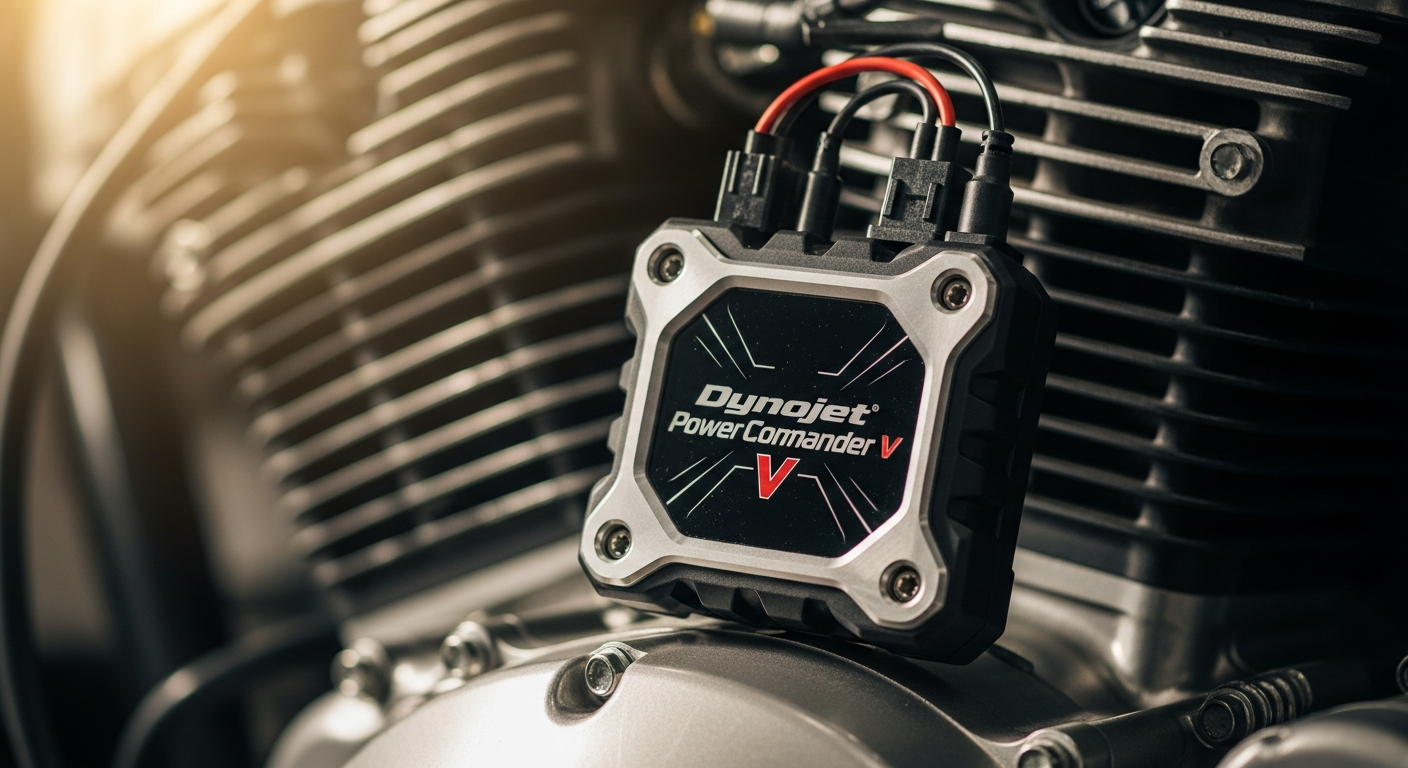
Most riders accept their bike's factory fuel mapping as gospel—but what if 70% of performance gains after bolt-on modifications come from proper fuel management alone? The stock ECU simply can't adapt when you bolt on an aftermarket exhaust or upgrade your air intake. This disconnect between what your bike can physically do and what its computer allows it to do is where tuning solutions step in.
The Dynojet Power Commander V has earned its reputation as the go-to fuel management system for riders who want precision control without the permanence of ECU flashing. Unlike flash tuners that reprogram your stock computer, this compact device works alongside your existing ECU, intercepting fuel injection signals and optimizing them in real-time. It's the kind of tool that serious riders reach for when their modifications demand smarter fuel delivery.
This guide walks you through what makes the Power Commander V different from other tuning solutions, shows you exactly how installation works for different platforms, and reveals the tuning strategies that unlock genuine performance gains. Discover how the Power Commander V can transform your bike's performance today.
The Piggyback Advantage: Why the Power Commander V Doesn't Modify Your Stock ECU
How piggyback fuel management intercepts and modifies fuel injection signals without altering the original computer
Piggyback tuning operates on a simple but elegant principle: intercept the signals traveling between your stock ECU and fuel injectors, then modify those signals in real-time before they reach the injectors. The Power Commander V sits inline with your fuel injection wiring, reading what your factory computer wants to do, then adjusting it based on a fuel map you've selected or created.
This approach means your original ECU remains completely unchanged. Every line of factory programming stays intact, still performing all its other functions—emission monitoring, idle control, cold-start enrichment, and everything else. The Power Commander V simply adds a layer of intelligence on top of the fuel delivery system.
The reversibility factor: returning to factory settings instantly if needed
One of the most compelling reasons riders choose piggyback systems over flash tuning is the ability to revert to completely stock operation at any moment. Disconnect the Power Commander V, and your bike returns to factory fuel mapping instantly. No software reflashing needed, no dealer visits required to restore factory settings.
This reversibility becomes crucial when troubleshooting other issues, dealing with warranty claims, or simply wanting to compare stock versus tuned performance back-to-back. You can swap between configurations in minutes.
Protection of manufacturer warranties compared to flash tuning approaches
Most manufacturers consider ECU flashing a modification that voids warranties. Flash tuning leaves permanent records in your ECU's software that service departments can detect. The Power Commander V's non-invasive approach doesn't modify anything the factory considers sacred—your stock ECU remains factory-original from a technical standpoint.
While warranty protection isn't guaranteed in all cases, the piggyback approach presents fewer warranty complications than flash tuning. Your modifications are visible but non-permanent.
Why non-permanent tuning appeals to riders with financed or leased vehicles
If you're financing your motorcycle or operating under a lease agreement, permanent ECU modifications create complications at trade-in or return time. The Power Commander V lets you enjoy custom tuning without creating permanent changes to the vehicle's computer. When you're ready to sell or return your bike, remove the tuner and your motorcycle returns to completely stock operation—no traces left behind.
Hardware Specifications That Matter: Breaking Down the Power Commander V's Design
Compact footprint (3" x 2.25" x 0.5") enabling discreet mounting under seats or in fairings
The Power Commander V's miniaturized form factor represents a major advancement over earlier piggyback systems. At just 3 inches by 2.25 inches with a thickness of half an inch, this device disappears into your bike's bodywork. Riders mount units under seats, inside fairing compartments, or behind side panels—locations where they remain completely hidden from view.
Earlier generations of fuel tuners required more visible mounting locations, which meant modifying fairings or accepting unsightly installations. The Power Commander V's diminutive size eliminates this compromise.
Lightweight construction at 9.6 oz minimizing unsprung weight concerns
At 9.6 ounces, the Power Commander V barely registers on your bike's weight distribution. For performance-focused riders obsessing over every pound, this lightweight design means tuning performance without sacrificing handling characteristics or accelerating unsprung components that affect suspension response.
USB-powered programming eliminating the need for separate 9-volt adapters
Configuration and map updates happen via USB connection to a computer running Dynojet's software. This USB power source eliminates the need for separate 9-volt batteries or specialized power supplies during setup. You connect to any standard computer, select your fuel map, and upload the configuration in minutes.
Fuel adjustment range from -100% to +250% for both lean and rich corrections
The adjustment range represents the breadth of corrections available. Negative percentages (down to -100%) allow you to lean out the fuel mixture for efficiency or response improvements. Positive adjustments (up to +250%) add fuel for high-boost applications, nitrous systems, or race fuel configurations. This expansive range covers nearly every tuning scenario from modest bolt-on modifications to heavily modified competition bikes.
Installation Reality Check: What You Actually Need to Know
Wiring harness access requirements and why tank removal is often necessary
Installing the Power Commander V requires access to your fuel injector wiring harness, which typically sits beneath the fuel tank or inside the fairings. Most installations demand fuel tank removal—a task that varies wildly depending on your specific motorcycle model. Some bikes allow fuel tank removal without dropping the motor. Others require frame notching or extended work.
Budget 2-6 hours for this phase of installation on most bikes, assuming you're working with basic hand tools and have mechanical aptitude. The exact time depends on your bike's design, how many fuel injectors you have, and your familiarity with electrical work.
Inline connector placement between fuel injectors and the stock ECU
The Power Commander V's wiring harness sits inline between each fuel injector connector and the stock ECU. You locate the existing connections, carefully disconnect them, and insert the Power Commander V's connectors into the gap. The process is straightforward—locate, disconnect, insert, reconnect—but it demands attention to detail and careful handling of electrical connectors.
Some installations place the unit inline with all four injectors (for four-cylinder bikes), while others require only single or dual injector connections depending on your bike's configuration. Dynojet provides application-specific harnesses that match your exact bike, eliminating guesswork.
Tools and skills needed for DIY installation versus professional shop labor
Basic hand tools—screwdrivers, pliers, and wrenches—handle most Power Commander V installations. The real requirement is comfort working under your bike's bodywork and dealing with electrical connectors. If you've removed your fuel tank before or performed similar maintenance, DIY installation is reasonable. If you've never cracked open your bike's fairing or worked with fuel system components, professional installation makes sense.
Shop labor typically runs $200-400 depending on your bike's complexity and local labor rates. This cost becomes meaningful if you're already purchasing the Power Commander V at the $300-500 price point. Factor installation into your total tuning investment.
Common installation mistakes that cause tuning difficulties
The most frequent error is reversed injector connector polarity—connecting power and ground backward on one or more connectors. This creates tuning problems that are frustrating to diagnose because the system appears to function normally but responds erratically to fuel adjustments.
Another common issue is loose connections that corrode over time, causing intermittent signal loss and poor tuning response. Always use dielectric grease on electrical connectors to prevent corrosion, and verify all connections are fully seated before starting your engine.
Incorrect fuel map selection for your specific application also plagues new users. Dynojet's map library is extensive, but selecting the wrong map—for instance, choosing a map calibrated for your bike model but without accounting for your specific engine modifications—creates suboptimal results that users sometimes mistake for tuning system limitations.
Pre-Configured Maps Versus Custom Tuning: Finding Your Performance Sweet Spot
Dynojet's extensive map library covering thousands of modification combinations
Dynojet's pre-configured map library represents decades of dyno testing and customer feedback. If you've bolted on a popular aftermarket exhaust and air filter combination, odds are strong that a proven fuel map exists for your exact configuration. The library includes base maps for stock bikes, then modifications for thousands of common bolt-on combinations.
Selecting a pre-configured map matched to your modifications gives you an immediate performance baseline validated by real-world testing. You're not experimenting on your bike—you're implementing changes that have already proven successful on similar machines.
How pre-configured maps serve as reliable starting points for common setups
Pre-configured maps rarely represent the final word on tuning. Instead, they serve as educated starting points. A map calibrated for your bike model with a specific exhaust and intake gets you 80-90% of the way to optimal fueling. From there, your riding conditions, local fuel quality, altitude, and personal riding preferences fine-tune the final adjustments.
Many riders find their pre-configured map delivers so much improvement over stock tuning that pursuing further customization feels unnecessary. Others use it as a baseline, then make minor adjustments through the Power Commander V's intuitive software interface.
Real-world performance expectations from out-of-the-box mapping
Expect noticeable throttle response improvements within the first few miles. The better-matched fuel delivery creates a crisper transition from idle to acceleration, with less hesitation or stumbling that stock ECUs often exhibit with aftermarket modifications. Horsepower gains typically range from 5-15% depending on your modifications and the efficiency of the pre-configured map.
Fuel economy often improves as well because better fueling reduces waste. You're burning fuel more completely instead of dumping excess fuel through the exhaust.
When custom tuning becomes necessary versus when stock maps deliver results
Stock maps deliver results for the vast majority of riders running modest modifications—exhaust, air intake, and maybe fueling improvements. Custom tuning becomes necessary when you've made substantial engine modifications (heads, cams, compression changes), added forced induction (turbo or supercharger), or integrated nitrous systems.
The presence of an optional AutoTune module that performs closed-loop adjustments automatically bridges the gap between static maps and custom tuning, offering middle-ground functionality that optimizes maps without requiring professional dyno time. Explore the AutoTune module options to see if real-time tuning optimization fits your tuning approach.
Measurable Performance Gains: What Riders Actually Experience
Throttle response improvements from optimized fuel delivery
The most immediately noticeable change riders experience with the Power Commander V is throttle response. Stock ECUs with aftermarket modifications often create a slight hesitation or delay between throttle input and engine response. This delay frustrates riders because their bike feels less responsive than it should, particularly in city riding or track conditions where crisp throttle response matters.
Optimized fuel mapping eliminates this hesitation. The throttle becomes snappier, the engine response more immediate, and the overall riding experience transforms from "this engine feels like it's holding back" to "this engine responds to what I'm asking it to do."
Horsepower increases documented on dyno tests with bolt-on modifications
Dyno test results consistently show horsepower improvements ranging from 5-15% when using the Power Commander V with typical bolt-on modifications. A bike producing 80 horsepower stock might generate 90-95 horsepower after adding an exhaust, intake, and Power Commander V tuning. While this isn't the dramatic 30-40% gains promised by some aftermarket claims, it represents genuine, measurable improvements.
The key factor is that the Power Commander V optimizes what your modifications make possible. Your aftermarket exhaust flows better than stock—the Power Commander V's fuel map extracts performance from that improved flow. Your intake breathes easier—the tuner ensures proper fueling for that increased air volume.
Smoother engine operation across the RPM range
Beyond raw horsepower numbers, riders report significantly smoother engine operation throughout the RPM range. The stock ECU's fuel mapping represents a compromise designed for emissions compliance and reliability across widely varying conditions. Custom maps can optimize fuel delivery for your specific bike, modifications, and riding style.
The result feels like your engine is running more efficiently at every RPM. Power delivery becomes linear rather than peaky, acceleration feels smoother, and the engine doesn't exhibit the hesitation or surging that sometimes plagues stock mapping with aftermarket modifications.
Fuel economy optimization through lean-burn tuning strategies
Counter to the perception that tuning always means running rich and consuming more fuel, skilled tuning often improves fuel economy. By optimizing the air-fuel ratio, you're burning fuel more completely. You need less fuel to produce the same power, which translates to real-world efficiency improvements.
Some riders specifically choose lean-burn tuning strategies that prioritize fuel economy, accepting slightly less peak power for meaningfully better mileage. Others pursue a balanced approach that improves both responsiveness and economy. The flexibility of the Power Commander V accommodates both philosophies.
Your Tuning Journey Starts Here
The Power Commander V fuel tuner represents a rare combination of proven performance, reversible installation, and accessible pricing that appeals to riders at every experience level. Whether you've just bolted on your first exhaust or you're a seasoned tuner chasing every last horsepower, this system delivers tangible results without the permanence of ECU flashing.
Your next step depends on your comfort level and goals. Mechanically inclined riders exploring tuning themselves find the extensive map library and user-friendly software make DIY feasible. Those prioritizing precision over budget discover that professional dyno tuning paired with the AutoTune module unlocks performance that rivals much more expensive solutions.
The modifications you've already invested in deserve fuel management that matches their potential. The Power Commander V bridges that gap—reliably, affordably, and without locking you into permanent changes. Start optimizing your bike's fuel delivery with the Power Commander V today.
Leave a Reply